
Geopolitical Oil Shocks, Energy Vulnerability, and Renewable Energy Resilience in Africa: Evidence from the Iran War Shock
DOI:
https://doi.org/10.62019/abgmce.v6i1.186Abstract
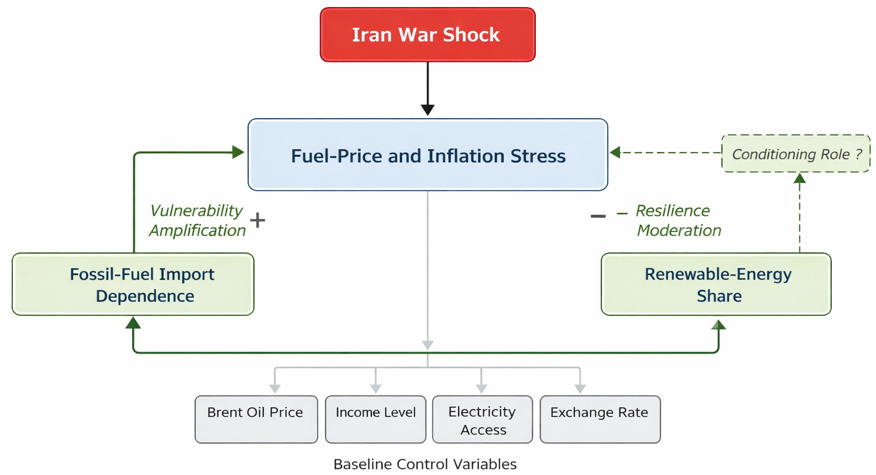
This study examines how the Iran war shock affected domestic energy and inflation stress across African countries and whether these effects depended on fossil-fuel import dependence and renewable-energy resilience. Using a monthly panel of 20 African countries covering April 2023 to March 2026, the analysis investigates the transmission of an external geopolitical oil shock into domestic fuel prices and inflation. The study applies fixed-effects, dynamic fixed-effects, and two-step system GMM estimators to assess both the direct effect of the shock and the structural conditions shaping country-level vulnerability. The results show that the Iran war shock significantly increased fuel-price and inflation stress across the sample. More importantly, the adverse effects were stronger in countries with greater net energy import dependence and weaker in countries with higher renewable-energy shares. These findings remain robust across baseline and dynamic specifications. The dynamic results further indicate persistence in domestic fuel-price stress, while the system GMM estimates confirm the continued significance of the shock and the mitigating role of renewable energy. By contrast, the exploratory three-way interaction provides only weak evidence that renewable energy conditionally offsets the additional vulnerability associated with fossil-fuel dependence. Overall, the findings suggest that Africa’s exposure to imported fossil fuels is a major channel through which geopolitical oil disruptions translate into domestic economic stress, whereas renewable energy serves as a measurable source of resilience. The study contributes to the literature by linking geopolitical oil shocks to African energy vulnerability in a panel-data framework and by showing that renewable transition should be understood not only as a climate strategy, but also as an energy-security and macroeconomic-stabilization strategy.
Downloads
Published
How to Cite
Issue
Section
License
Copyright (c) 2026 Baboucarr Nyang, Lamin Dampha, Joab Okando, Muhammed Lamin Saidykhan, Marina Agortimevo

This work is licensed under a Creative Commons Attribution 4.0 International License.
CC Attribution 4.0


